
Hey,
I'm Pratyush!
I build products, operating models, and AI systems that help organisations build faster.
What I do
- Turn ambiguity into product direction
- Bridge strategy and engineering
- Build AI-native product workflows
- Build zero-to-one products

Sculptor Award
Annual company-wide honours for innovation and organisation-wide impact.
Systems, frameworks and products that demonstrate strategic thinking.
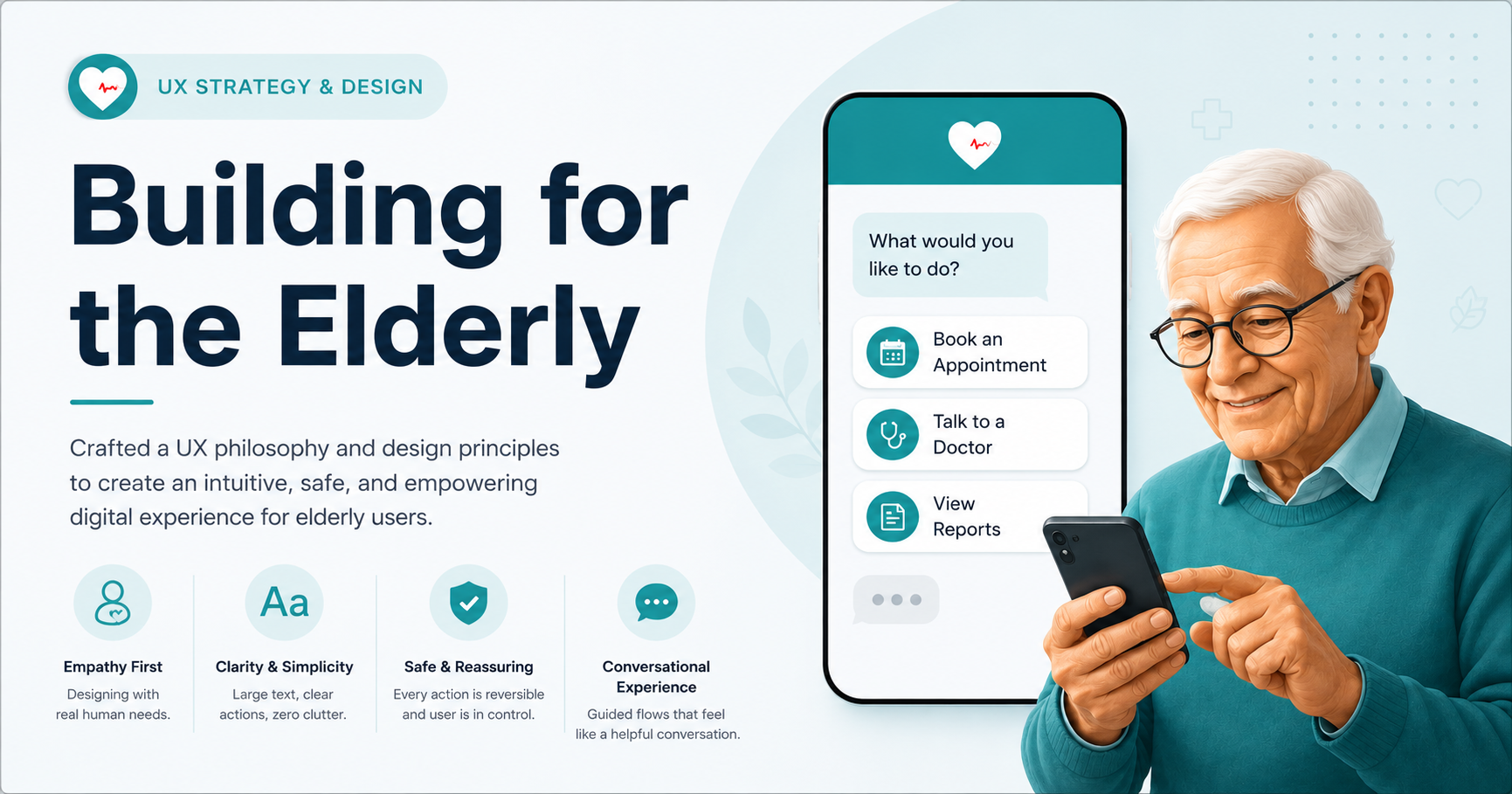
Building for the Elderly
Designing mobile experiences for people who were never meant to learn smartphones.
Our mission is to build a digital experience for the elderly that serves them functionally and emotionally—with clarity, ease, and respect. Through six core UX principles—predictable navigation, design that respects hands and eyes, visual hierarchy, intentional simplicity, conversational interfaces, and confidence-building design—we created an app that empowers elderly users instead of challenging them.
Read the UX Preamble →Sonex
An AI orchestration layer that turns conversations into product actions.
Voice is easy. Reliable execution isn't. Sonex translates natural language into structured API calls, allowing AI assistants to interact with real products instead of simply generating text.
Explore Sonex →Friday
AI teammates for modern product teams.
Discovery. Scoping. Prototyping. Documentation. Friday is a collection of specialized AI workflows that remove repetitive work and accelerate product execution across the software lifecycle.
Meet Friday →PROVE
From ideas to measurable signal in one week.
PROVE is an operating model for rapidly validating product hypotheses through aggressively scoped one-week MVPs. It combines structured discovery, disciplined scope and rapid execution into a repeatable system.
See the Framework →Doc Labs
Where ideas become frameworks.
Every product teaches something. Doc Labs captures those lessons as reusable playbooks, operating principles and decision frameworks—turning experience into systems others can build with.
Browse the Labs →My career has evolved through four distinct phases
-
Phase I
Building Products
Enrole
- Learned product development from first principles as a founder.
- Built software, talked to customers, sold the product, and owned the complete lifecycle.
-
Phase II
Scaling Products
Toprankers / ProBano
- Built products used at scale.
- Focused on automation, algorithms, product-led scale, and operational efficiency.
-
Phase III
Building Across Domains
PlayVerse
- Built zero-to-one products across marketplaces, blockchain gaming, fantasy sports, and commerce.
- Learned that great product thinking transfers across industries.
-
Phase IV
Building Product Systems
Utsuk
- Designed PROVE, a hypothesis-to-MVP framework that became the company's default operating model for PoC execution.
- Built AI workflows that accelerate product discovery, scoping, and rapid prototyping.
- Conceived Friday, an AI-powered project intelligence initiative.
- Created Sonex, a speech-to-intent SDK for embedding AI assistant experiences into applications.
- Worked directly with the CEO and CFO on AI transformation and new product incubation.
Five ideas I keep returning to.
Start with uncertainty
Every product begins with uncertainty.
Before discussing solutions, I identify what we know, what we're assuming, and which assumptions matter the most. The goal isn't to eliminate uncertainty—it's to make it explicit.
Listen before you solve
The people closest to the problem usually understand it better than anyone in the meeting room.
When building products for truck drivers, warehouse operators, caregivers, or construction teams, I spend time understanding how work actually happens. Executives understand goals. Users understand reality. My job is to bridge the two.
Domain expertise isn't something I walk in with. It's something I earn by listening.
Chase the fastest measurable signal
I don't optimize for building an MVP.
I optimize for creating the earliest measurable signal that tells us whether we're moving in the right direction.
Sometimes that's five customer interviews. Sometimes it's a prototype. Sometimes it's a one-week proof of concept.
The artifact changes. Learning doesn't.
Design systems, not heroics
Great products aren't built by exceptional Product Managers.
They're built by teams with repeatable ways of discovering, validating, and delivering products.
That's why I enjoy designing operating models and execution frameworks just as much as building products themselves.
AI should amplify judgment, not replace it
AI is exceptional at compressing repetitive work—discovery synthesis, product scoping, documentation, and rapid prototyping.
The objective isn't fewer Product Managers.
It's giving product teams more time to think, make better decisions, and solve harder problems.
Some of what I've built.
Enrole
Learning product management from first principles
Enrole was where I learned that products aren't validated when they're shipped—they're validated when customers choose them.
As a founder, I wore every hat: product, engineering, sales, customer support, and implementation. Building software was only half the job. The other half was understanding why people would—or wouldn't—use it.
It shaped the way I approach every product today.
PROVE
Reimagining how consulting teams build products
Most Proof of Concepts fail because they try to prove too much.
PROVE challenged that assumption by redefining success around learning velocity instead of feature completeness. It introduced clear hypothesis-driven execution, strict scope boundaries, and rapid validation cycles, eventually becoming Utsuk's default operating model for new PoC engagements.
It wasn't just a framework—it changed how the organization approached product discovery.
Friday
Bringing intelligence to product execution
Requirements don't drift because teams stop communicating.
They drift because context changes faster than documentation.
Friday explores how AI can continuously understand evolving project context, surface hidden risks, detect requirement drift, and help teams make better decisions throughout product development.
It's my attempt at bringing continuous intelligence into product execution.
Sonex
Making AI experiences effortless for developers
As AI becomes a standard part of modern applications, developers shouldn't have to rebuild the same assistant experience every time.
Sonex is a speech-to-intent SDK that enables developers to embed AI assistant experiences into their applications within minutes.
My goal is simple: make natural language interaction as easy to integrate as authentication, analytics, or payments.